Beginner to Full-Stack in 6 Months
Introduction
Do you want to become a full-stack developer within 6 months, starting from ground zero? You are at the right place. In this article, you will learn exactly what to do to become a full-stack software engineer within 6 months. You will have the ability to start working on full-stack applications, collaborate with others, and earn money from working with a company or freelancing. Without further ado, let’s jump into it!
Philosophy for Learning
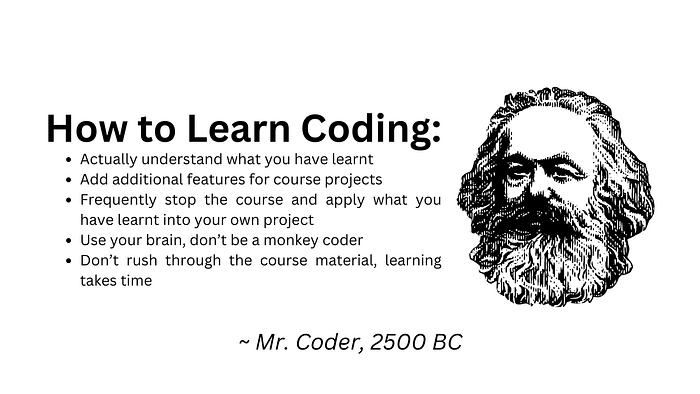
Learning is not just consuming information. Learning involves gathering information and using it. If you want to solidify the concepts from a course or guide, you must build something on your own with it. To take it a step further, you can go above and beyond for each course outlined in this article, expanding the course projects by adding your own touch. Don’t be a monkey coder. Use your brain.
I have provided ideas on what you can do to apply what you have learned for each section. For each section, I recommend following only one resource.
The Basics
The basics of HTML, CSS, and JavaScript are the first building blocks for becoming a full-stack developer. From doing multiple HTML, CSS, and JavaScript courses, I have concluded that freeCodeCamp is one of the best places to learn it.
Why listen to me? Emma Bostian landed her dream job at Spotify:
“I’ve always struggled with learning JavaScript. I’ve taken many courses, but freeCodeCamp’s course was the one that stuck. Studying JavaScript, as well as data structures and algorithms on freeCodeCamp, gave me the skills and confidence I needed to land my dream job as a software engineer at Spotify.”
freeCodeCamp offers two courses that I recommend you follow:
Both of them are project-oriented. You will have simple projects that you can put on your LinkedIn and personal portfolio after completing the two courses. I recommend making a really good personal portfolio on your own if you want to take an extra step. This will solidify the concepts you have learned.
Git and GitHub
Git and GitHub allow you to collaborate with other people and perform version control. It is essential to know the basics of both Git and GitHub as they are requirements for all engineering jobs. Here are some valuable resources I have found:
You will be an expert in using Git if you read the book above. It isn’t necessary if you are just starting out, but it will be a major advantage if you do.
Here are some ideas to test your Git and GitHub skills:
- Collaborate with a friend on a coding project
- Solve 25 Stack Overflow questions related to Git and GitHub
Frontend Libraries
Building websites with just vanilla HTML, CSS, and JavaScript is like going to a gold mine with a fork. It will work, but there are more efficient ways of building web apps. Frontend libraries have a bunch of built-in features that make developing frontend interfaces much more convenient. Here are some valuable courses I have found:
Here are some project ideas:
- Improved personal portfolio
- AI Image Generator Web App
Databases
Databases are used to store user data or any other form of data. Databases store text in an organized format. There are two main types of databases:
- Relational Databases
- NoSQL Databases
Relational databases store data in tables, where there are columns and rows, just like a Google spreadsheet. SQL databases are relational.
On the other hand, NoSQL databases store data in other formats.
Here are some courses I recommend you follow:
Project ideas:
- RPG Terminal Game — Store user information and stats in a database. Allow users to sign up or sign in with email and password.
- AI Video Summarizer Web App
Backend Development
Up to this point, you have learned the fundamentals of frontend development. In the real world, applications usually have servers that serve as the internal API for the frontend user interface.
Here are two courses; pick one that interests you more:
Project ideas:
- Blogging Platform
- Simple E-commerce Platform
Quality Assurance
As web applications become more complex, you will want to test them to ensure they don’t break. Automated testing is a must when working on large applications.
Here are some resources:
Project ideas:
- Automated UI Tests for Web Application (for a project you have built previously)
- API Testing for RESTful Service — Write automated unit tests for any API to ensure functionality, speed, and security are at a high standard.
Full Stack Frameworks
Everything up to this part has had the frontend and the backend separate. Does it have to be that way?
Full-stack frameworks allow you to create both the client and server in one root folder in a conventional way. Here are free resources for the most popular full-stack frameworks:
Some project ideas:
- Online Code Editor Web Application
- YouTube Video MP3 and MP4 Downloader
Conclusion
You know how to become a full-stack developer within the next 6 months. It is time to take action. If you can spend an average of 4 hours a day following the steps outlined in this article, you will be able to call yourself a full-stack developer within 6 months.
Knowledge without action will not be good enough. Save this article somewhere so that you don’t forget about it. I truly believe that you will be able to follow this for the next 6 months. It is absolutely worth it.
That is it for this article. If you have found this valuable, consider reading 🚀 Just Completed 300+ Hour JavaScript Course on freeCodeCamp! 🎉💻.